
Atomic fisson is well known and understood process when a neutron slams into a larger atom forcing it to excite and split into two smaller atoms—also known as fission products The released neutrons can then go on to collide with other atomic nuclei, causing a chain reaction [1]. Because it works without fire, they emit no air pollution or greenhouse gases.
We can control and convert that energy into electricity that power our modern society, heating our homes and water desalination and to produce fertilizer.
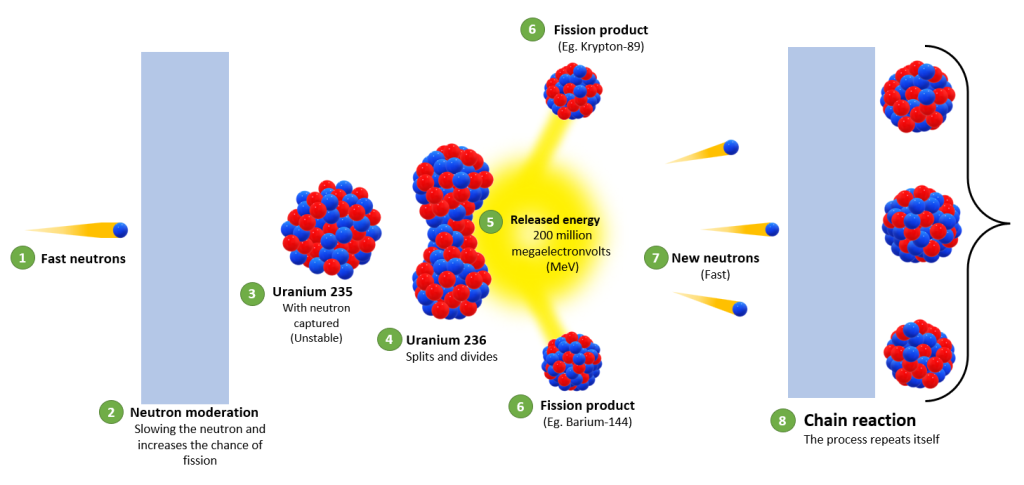
Spliting the atom releases tremendous amounts of energy. A single uran fuel pellet contains as much energy as a ton of coal 147 gallons of oil or 17 000 cubic feet of natural gas [2]. And thats that’s with the current method through low enriched uranium in light water reactors that only use about 5 % of the potential energy in a fuel pellet. If all the fuel in a uranium fuel pellet is completely fissioned, it can release energy that is approximately 20 times greater.

Because uranium is very energy dense, the amount of waste is relatively small and ithas never caused harm to people or the environment [3]. The comming 4 generation of nuclear will more than 99% of the energy in the fuel and recycle existing spent fuel and reduce all long-lived isotopes [4]. The international environmental campaign group RePlanet estimates that if the existing stocks of spent fuel are recycled as fuel for advanced fast reactors, it could generate carbon-free electricity for Europe for up to 1000 years. The remaining fission products will return to a level of radioactivity comparable to the original uranium ore within 200-300 years [5].
Because uranium is highly concentrated, the fuel costs for nuclear plants are a minor approx. 15% proportion of total generating costs and most of this is due to uranium enrichment, not uranium mining. It’s easily and cheaply transportable. A doubling of the uranium market price would increase the fuel costs very little compared to doubling the gas price. As of 2023, the global nuclear fuel cost is 0.46 ¢/kWh. Even if it increased by 100% it was still less than 1 us cent per kWh [6].
Nuclear conserves the land. Because of the density of fuel, nuclear power plants can make a lot of energy in small spaces. This means that with nuclear we can use less land for energy generation and leave a lot more land for nature.
Sources #
- Nuclear fission – Wikipedia
- Nuclear Fuel (nei.org)
- What is nuclear waste and what do we do with it? – World Nuclear Association (world-nuclear.org)
- Generation IV Nuclear Reactors: WNA – World Nuclear Association (world-nuclear.org)
- What A Waste Report (replanet.ngo)
- https://world-nuclear.org/information-library/economic-aspects/economics-of-nuclear-power.aspx?fbclid=IwAR03QxP8JAVUjrjSPmvgnSgtDIKN3selOvR-XD3tTM7YugW9FG0xjE4FfWY#:~:text=At%2045%2C000%20MWd%2Ft%20burn,to%20the%20Nuclear%20Energy%20Institute


