
Global energy consumption is skyrocketing and will double by 2100 | Energy drives development and is the foundation of modern societies. Poor countries demand more energy and rich countries cannot reduce energy consumption | It is inhumane to want to maintain the low energy consumption of developing countries. Getting out of (energy) poverty | We will need even more clean energy if we are to make a green energy transition | Only nuclear power can provide huge amounts of clean energy without industrializing nature.
A cornerstone of the old-fashioned environmental movement’s climate solution is a drastic reduction in energy consumption. They regularly present seductive analyses claiming that we can achieve 100% renewable energy without any problems. However, the imaginative analyses always contain drastic reductions in energy consumption and, unfortunately, often also lots of climate-damaging and nature-hostile biomass.
The problem with the idea of a low-energy society is that access to large amounts of reliable energy is the entire prerequisite for our modern society with all the welfare, education, health, science, art, and material security that we Danes today take for granted. The low-energy society, therefore, represents a politically unsellable and immoral austerity doctrine. You are foolish if you think that modernity and prosperity can be canceled down by democratic means and that humanity cannot and should not drastically reduce its energy consumption.
We can, and should, in turn, switch to CO2-free and environmentally friendly energy sources that can provide stable and abundant energy. If you base your proposed solution on a low-energy society that can never be realized, you are gambling with the climate. It, therefore, blinds itself to the need for nuclear power, which is the only energy source that can provide huge amounts of clean and reliable energy, as a climate- and nature-friendly high-energy society requires.
This analysis refutes the low-energy fantasy: there is nothing to suggest that we will use significantly less energy in the future, neither in rich countries nor in developing countries. In fact, the opposite is true, as the globally increasing prosperity and the climate solution itself require larger amounts of energy than the world uses today. The analysis will be followed by another essay presenting a realistic and progressive alternative: The nuclear-humanistic high-energy society, where there is ample clean energy to ensure both climate, nature, and prosperity.
No country has succeeded in rapidly reducing energy consumption – not even those keen on climate change
History has shown that it is a difficult challenge for modern high-energy societies to reduce energy consumption. In 2019, Denmark’s energy consumption was only 0.5 percent lower than it was in 1990:
Since the oil crises in the 70s, Denmark has otherwise tried to reduce energy consumption, and the ambition has been intensified since the 90s for climate reasons. That is why politicians have tried several initiatives for energy efficiency improvements and energy savings in business and society in general. However, as Figure 1 shows, the measures have not had any significant effect on total energy consumption from 1990-2019.
This is not an expression of Danish incompetence, but instead a general pattern throughout the Western world – energy consumption has remained constant despite increasing desire to reduce it for climate reasons.
No country in the West has thus succeeded in significant reductions in energy consumption. The tables cover a period in which a large part of energy-intensive production has moved to countries with cheap labor and energy. Our IKEA furniture is now made in Poland, our ships in Korea, and consumer electronics in China. The energy used in the production of our imported goods does not, therefore, count in our official energy accounts, but is instead included in the production countries.
If you adjust for imports/exports – i.e. include the energy required to produce the goods we import and exclude the energy from products we export – the real energy consumption of Danes and other Westerners will therefore be higher today than it was in 1990. For example, with data from Statistics Denmark and the Global Carbon Project, we have calculated that the real energy and climate footprint of Danes has increased by 5% since 1990.
From a global perspective, the scale of the challenge is only increasing. As can be seen in the graph below, the world’s energy consumption has exploded over the past 50 years as the global middle class has grown significantly – a development that will continue for a long time to come.
Why don’t rich countries reduce energy consumption for the sake of the climate?
If it has apparently been a political desire for decades to reduce energy consumption, why is this not happening? The short answer is that high energy consumption brings prosperity, welfare, and opportunity and that politicians will not be elected if they undermine these benefits.
The magic of energy consists in liberating people. When you have the energy and technology to utilize the energy, you can let the machines do the hard and dirty work.
In low-energy societies, humans simply have the energy that their own bodies and perhaps a few draft animals can offer. There is barely enough energy to provide basic necessities such as food, water, and shelter and no material surplus at all to support modern education and health systems. In low-energy societies, the majority of the population lives in the countryside, where they wear themselves out to (perhaps) be able to get enough food on the table. For most people, life is hard, short, and poor – both mentally and materially.
In industrialized, high-energy societies, there are no problems in providing enough food for the population. Basic needs are met by all, and there is universal access to health and education. The average child born in energy-rich Denmark has a world of opportunities with school, high school, a gap year in Asia, and then a wealth of educational and job opportunities. Average children born in energy-poor Ethiopia are lucky if they get six years of schooling and a job in a factory. In low-energy societies, children of need are often used as labor in agriculture. In high-energy societies, children just need to be children, go to school, play, and develop into educated people.
With a higher energy consumption, material security is created, which provides a psychological surplus. The psychological surplus gives people the mental capacity to reflect on immaterial problems such as democratic rights, equality, culture, environment, climate, and many other topics that do not relate to daily bread. In other words, in society, what sociologist Ronald Inglehart called “postmaterial values” arise, which are the manifestation of Maslow’s psychological pyramid of needs at the societal level. At the same time, the population’s ability to innovate increases, so that more challenges in human life can be solved by energy and technology. For example, in high-energy societies, we can develop medical devices, medicines, and vaccines to avoid or survive diseases from which we would otherwise die.
Maslow’s pyramid of needs: In 1942, the Russian psychologist Abraham Maslow set up a graphic representation of human needs in the so-called Maslow’s pyramid of needs. His contention is that needs must be met from below in the pyramid. In other words, the need for food, water, heat, etc. must be met before we can begin to cover the need for physical and social security
Source: Wikipedia
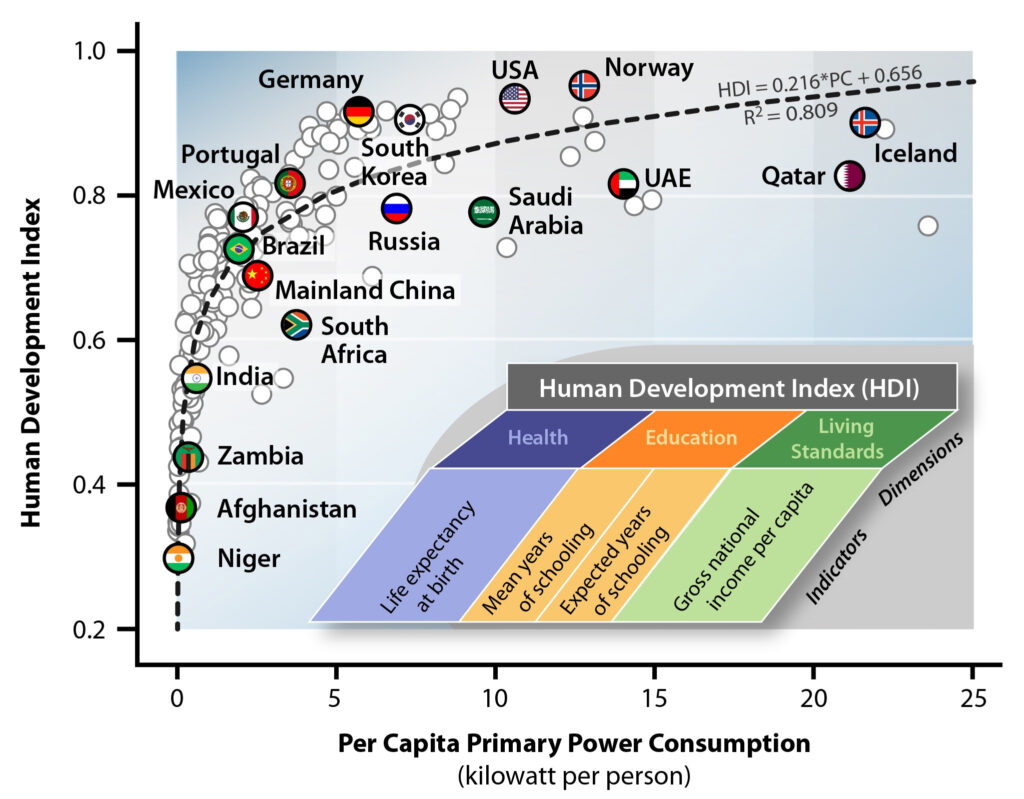
For these reasons, populations in high-energy societies have higher living standards than populations in low-energy societies. If you take a look at the so-called Human Development Index (HDI), which captures countries’ economic prosperity, health, and level of education, it quickly becomes clear that high-energy countries are at the top and low-energy countries at the bottom (see Figure 7).
Figure 7. Human Development Index and energy consumption per capita
Source: Energy Poverty Awareness
Below we delve into individual aspects of human development, and here is the same trend: Countries with high energy consumption have significantly lower infant mortality, extreme poverty, and better general health and thus higher life expectancy, as seen in Figures 8, 9, and 10, respectively:
Figure 8: Energy consumption per capita and infant mortality.

Colors indicate continent (Asia=red, Africa=blue, North and South America=green, Europe=yellow). The size of the circles indicates the population size of the country. Source: Gapminder.org/tool
Figure 9: Energy consumption per capita and extreme poverty as a proportion of the population living on less than $5.50 per day
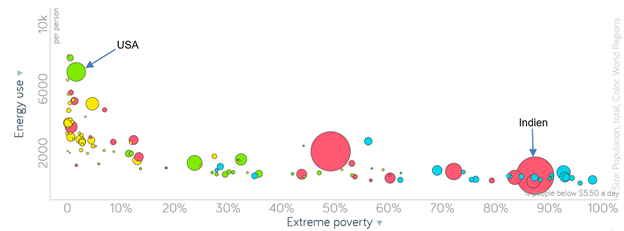
Colors indicate continent (Asia=red, Africa=blue, North and South America=green, Europe=yellow). The size of the circles indicates the population size of the country. Source: Gapminder.org/tool
Figure 10: Energy consumption per capita and life expectancy.

Colors indicate continent (Asia=red, Africa=blue, North and South America=green, Europe=yellow). The size of the circles indicates the population size of the country. Life expectancy is considered in public health science to be one of the best indicators of the general state of health of the population.
Source: Gapminder.org/tool
In addition to the fact that higher energy consumption leads to better health, it also gives the population the physical and mental energy to fight for political rights such as freedom of expression and assembly and for democratic representation. As Figure 11 shows, countries with high energy consumption, except oil-rich dictatorships in the Middle East, are high on the democracy index. India is actually also a country that breaks the trend, as they score relatively high on the democracy index, even though they have a low energy consumption. There are, of course, many other factors at play in the development of a functioning democracy.
Figure 11. Energy consumption per capita and democracy.
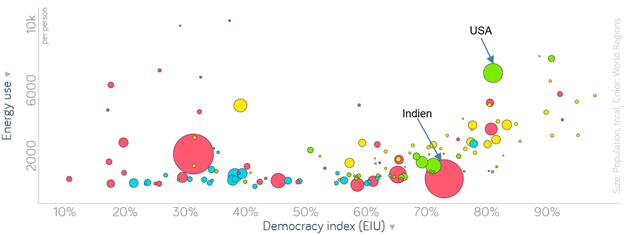
Colors indicate continent (Asia=red, Africa=blue, North and South America=green, Europe=yellow). The size of the circles indicates the population size of the country. Democracy is measured through an index that captures all aspects of what a functioning democracy should entail. Source: Gapminder.org/tool
A concrete example of how energy-powered machines liberate people and enrich life isThe invention of the washing machine. Before the advent of washing machines, laundry was a tough and time-consuming task (typical) for women. It took one or more days to obtain water and firewood to heat the water and later to wash the clothes by hand. The washing machine does it all in an hour. It freed up women’s time and was instrumental in enabling women to enter the labor market, fulfill their intellectual potential in the education system, fight for gender equality, and have more quality family time.
Washing machines, refrigerators, cars, trains, computers, tractors, and many more energy-powered machines have thus liberated and intellectualized the people of industrialized societies. It is utopian to think that Westerners do not want to retain the benefits that high energy consumption brings.
Although many more of the Western world’s population in recent years has – fortunately – begun to worry about the planet and especially climate change, everything indicates that the vast majority are not willing to give up modern life. An opinion poll for Politiken shows, for example, that a large majority of Danes living in the world’s most climate-minded country are opposed to high climate taxes on, among other things, fuels. And if you look at the number of Danish air passengers (before Covid-19), there is nothing to indicate a change in climate behavior among Danes.
Figure 12: Air passengers in Denmark

Air travel is also a luxury good, so there is an infinite way to go to get the population to give up the more basic benefits of modern energy-rich living. This applies both to direct energy-related benefits, such as driving to work or heated homes, but also to benefits related to the prosperity that high energy consumption brings, such as access to good healthcare and education systems. Drastic reductions in energy consumption will force factories to close in a row and jobs to disappear, thus making the economy significantly weaker. The treasury will receive less tax revenue, which will directly affect the quality of welfare that the state can offer the population.
Reducing energy consumption is therefore hardly a political agenda that wins elections, as energy increases our opportunities, reach, health, and quality of life. That is why politicians talk a lot about climate problems, but have extraordinary difficulty solving them, as long as they want to avoid the huge source of climate-friendly energy that nuclear power can provide.
The most paradoxical thing is that our high energy consumption and prosperity are the entire prerequisite for us in rich industrialized countries to have the mental energy to worry about complex challenges such as climate change and environmental pollution, even though the consequences of these problems will hit the (energy) poor countries hardest.
Is it realistic that poor countries will maintain low energy consumption? And should they?
The low-energy solution, as described above, is not a political agenda with the potential to win elections in rich industrialized countries. But what about the rest of the world’s population, who have not become accustomed to the same high standard of living? Will these populations maintain low energy consumption? There is nothing to suggest that.
According to the UN Sustainable Development Goals Survey, people in poor countries (low HDI) want to achieve modern social goods: They prioritize education, health, and job opportunities. Better infrastructure and access to reliable energy also score highly, while climate is given the lowest priority (Ranked 16 out of 16, see Figure 13). Even in rich countries, the climate is given relatively low priority (10 out of 16, see Figure 13).
Figure 13. The UN Sustainable Development Goals survey, which shows which SDGs the population wants prioritized

Source: UN Sustainable Development Goals Survey 2015
The low-energy utopia implies a deeply immoral and unrealistic assumption that poor populations will accept continued energy poverty, even though they clearly want a different and better life.
An example of how far we are from sufficiently good living standards globally is that, according to the WHO, three billion people (about 40% of the world’s population) are Still allowed to use wood and other biomass for home heating and cooking over indoor fires. In addition to having to put a lot of effort into getting enough food on the table, many of these people have to spend several hours daily collecting firewood. It is typically women and children who have this task of collecting firewood, which discourages them from productive activities that could benefit their human development, such as getting an education and getting a job.
In addition, indoor air pollution created by this burning is one of the world’s biggest killers. According to the WHO, 3.8 million people die each year from indoor air pollution due to the harmful particles that can cause pneumonia, lung cancer, COPD, cardiovascular disease, and several deadly diseases. In comparison, less than 0.5 million die annually from malaria.
We do not believe that the Western world, because of otherwise well-intentioned concerns about climate change, has the moral authority to deny the world’s poorest a higher energy consumption. On the contrary, it should be self-evident to give priority to higher energy consumption for the billions of people who do not yet enjoy the fruits of energy.
Even if the West tries to limit energy consumption in poor countries lacking industrial development, it will have no way of imposing it, as all states have sovereignty and therefore cannot be subject to the will of other states or international bodies.
Global energy consumption will increase for many decades to come
Since rich industrialized countries with high energy consumption are unable to reduce energy consumption significantly, and poor developing countries at the same time want to increase energy consumption, it is, therefore, logical that there should be an increase in global energy consumption every year.
The biggest increase in energy consumption occurs in Asia, where the middle class will explode in the next three decades. Then the same thing will happen in Africa. Africa’s population will rise from 1.2 billion in 2016 to 4.3 billion in 2100 and will end up on par with Asia’s population. By the year 2100, the world economy is even expected to be 5 times as large as today. All the people and growth require energy. Thus, global energy consumption will in all likelihood increase linearly – also beyond the year 2050.
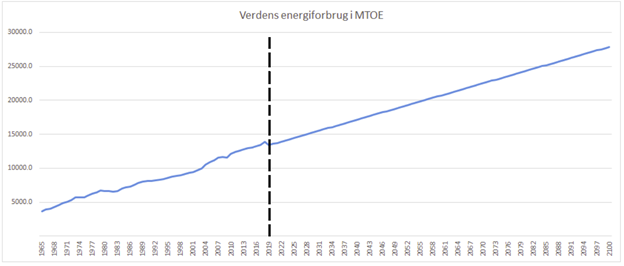
If you make a simple linear projection of the world’s energy consumption, the pattern looks like this:
Figure 14. Linear projection of world energy consumption
Source: BP Statistical Review of World Energy 2019
In 2019, energy consumption was 13,396 MTOE (MTOE is energy consumption calculated in oil equivalent), while according to the projection in 2050, it will be 18,941 MTOE – an increase of 41%. By 2100, energy consumption will be 27,885 MTOE – an increase of 108%, approximately doubling.
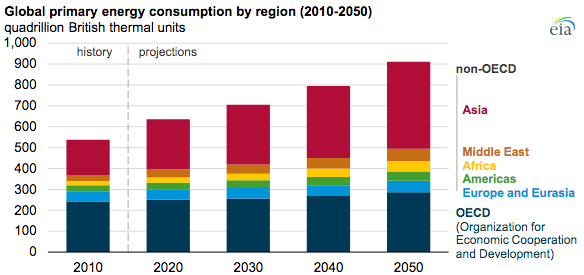
Our simple linear projection is supported by calculations by the International Energy Agency (IEA), which, however, only makes predictions twenty years ahead. The US DEA also predicts a fairly linear trend of a 44% increase in global energy consumption from 2020 to 2050, as illustrated in Figure 15:
Figure 15: Projection of global energy consumption by the US Energy Agency
Source: US Energy Agency, 2019
Energy consumption will continue to increase, although there is likely to be a lot of progress in energy efficiency. The harsh reality is that the reduction from energy efficiency improvements is not at all comparable to the growth in energy consumption.
In addition, energy efficiency improvements have a tradition of working much better on paper than in reality. When energy efficiency improvements make it cheaper to use energy for a purpose, we can afford to use more energy, and therefore the total energy consumption will not necessarily decrease. For example, airplanes today use less than half as much fuel per kilometer traveled as in 1970. This has contributed to the price of airline tickets tumbling down – which is why we fly more today than ever before, and the total emissions from the airline industry per capita have multiplied.
The phenomenon is called the rebound effect or the Jevons paradox. According to the Intergovernmental Panel on Climate Change (IPCC), the rebound effect is “eating” in rich industrialized countries typically between 20-60% of the initial energy savings depending on the sector in which efficiency is improved. According to the IPCC, the rebound effect is even significantly higher in developing countries, where people have a higher demand to spend money on energy-intensive goods.
The necessary clean energy transition will require even higher overall energy consumption
Perhaps the best argument for why it is unrealistic to both reduce energy consumption and at the same time switch to clean energy is that it requires much more clean than fossil energy to obtain enough energy for all purposes in society, which is largely geared towards the use of fossil energy sources. The explanation is that fossil energy sources are used for much more in society than generating electricity. If the challenge was “just” about switching to green power, the climate crisis was a completely different matter, but in both Denmark and the world, power consumption accounts for less than a fifth of the total energy consumption.
In some sectors are possible to switch to the use of electricity as a final energy source. This applies, for example, to passenger cars, where electric cars can replace gasoline cars. However, the situation is different with regard to industry and heavy goods transport, such as lorries, and especially sea and air transport. Fortunately, however, it is possible to use CO2-free power to make synthetic fuels that do not emit CO2.
It is called power-to-x (PtX) because the power can be used to form many different kinds of fuels (hence the x-et). The process of converting power into synthetic fuels first takes place via electrolysis, where water molecules are split into hydrogen, which is then mixed with carbon from either biomass or directly recovered from the atmosphere to liquefy the fuel. Burning these fuels (e.g. methanol) emits the same amount of CO2 that is recovered from the atmosphere or embedded in the biomass (e.g. straw) used to form the fuel. You can also use the electricity to make fuels based on nitrogen, which does not emit CO2 at all (e.g. ammonia). In some cases, you can also use hydrogen directly as fuel, but since hydrogen is a gas, it is often problematic.
That sounds great, you might think. However, the problem is that there is a huge loss of energy in this process. If you need to use synthetic fuels based on green power for fuel in, for example, trucks, ships, or aircraft, there is an energy loss of at least 55-60%, in addition to the usual as there is in internal combustion engines in, for example, cars.
Let’s imagine that we wanted to replace 1 kilogram of gasoline with 1 kilogram of green PtX methanol. To produce this kilogram of methanol, we need about 2.3 times more energy, than methanol contains. Producing one kilogram of methanol, which contains 19.7 Megajoules (MJ) of energy, will thus require 45.7 MJ of electrical energy, and the energy loss in the production is thus 26 MJ. Figure 16 below shows how much energy it takes to produce synthetic fuels on which a car can travel one kilometer. The percentages indicate how much of the original energy is retained in the PtX fuel.
Figure 16. Energy losses from power-to-x based fuels for transport vehicles.

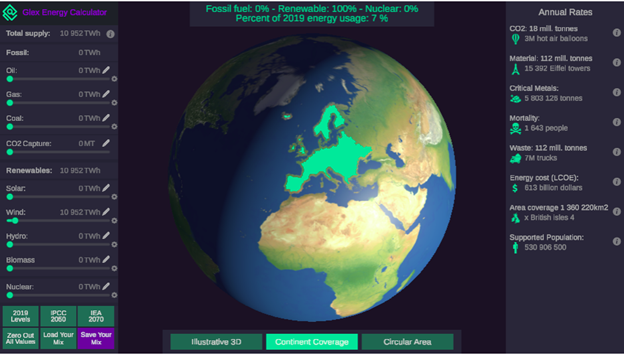
In other words, machinery, transportation, and industry powered by PtX fuel require roughly twice as much original energy as their fossil-fueled competitors. A study by the Norwegian Climate Association has shown that it would require up to 11,000 terawatt-hours (TWh) of power to produce enough PtX (ammonia) to power the world’s shipping. If these 11,000 TWh were to be produced with onshore wind, it would require a wind farm the size of most of Europe:
Figure 17. Area size required to produce wind energy to supply the world’s shipping with synthetic power-to-x fuels
Source: Glex Energy Calculator
Today we do not have enough CO2-free electricity for this ammonia production, which would require 11,000 TWh of clean electricity: Out of the world’s annual electricity production of 26,500 TWh, 9,000 TWh comes from CO2-free energy sources – of which 1,800 TWh from solar and wind, 2,700 TWh from nuclear power and 4,300 TWh from hydro power.
Since 1990 and until today, the world has increased power production from CO2-free sources by approximately 5,500 TWh, i.e. half of shipping’s need for power for PtX. Thus, at the current pace, it will take 56 years before the world’s CO2-free electricity production has grown enough to cover just shipping’s need for power for PtX. The figures come from the International Energy Agency (IEA) – and are shown in Figure 18:
And that’s just to transform a single sector that represents just 2% of total CO2 emissions. The energy demand for the entire green transition is thus absolutely enormous.
Another important reason why the world cannot solve the climate challenge without increasing energy consumption is that we must not “only” achieve CO2 neutrality, but CO2 negativity, i.e. remove more CO2 from the atmosphere than we emit. The majority of CO2 gases remain in the atmosphere for several centuries. As a result, we have a huge CO2 debt floating in the atmosphere – which must be repaid.
CO2 negativity can be achieved by sucking CO2 out of the atmosphere, but it is a gigantic energy-intensive process, both in terms of electricity and heat. A study published in the renowned journal Nature has shown that in the long term, an amount of energy equivalent to half of the world’s existing energy consumption may be needed to suck enough CO2 out of the air to meet the Paris Agreement’s ambition.
The third and final reason is that whatever we do in the next 30 years, there will be climate change. Climate change requires large-scale climate adaptation, which requires a lot of energy. Energy demand is mainly driven by the need for air conditioning in areas that are getting warmer and hit by more and harsher heat waves. But the need for increased coastal protection, including more robust buildings, as well as the increased water consumption for farming in dry areas, will also require increased amounts of energy.
Now that we are on the subject of water consumption, it should be mentioned that it is also a great challenge to ensure enough clean water for the planet’s population. The UN has estimated that water scarcity could be a recurring problem for up to 5 billion people by 2050. Therefore, globally, we will be forced to desalinate large amounts of seawater in order to provide enough fresh water for the global population. Desalination also requires a lot of energy.
Slowing down and mitigating climate change is thus in itself a tremendously energy-intensive task, and even if humanity stopped demanding more energy for its own consumption, our climate fate would mean increased energy consumption due to 1) energy loss from PtX production 2) CO2 suction, and 3) climate adaptation. For anyone who takes the climate challenge seriously, it should therefore be abundantly clear that we cannot avoid using more energy if we want to solve the climate problem.
So what do we do now?
The reality is that world energy consumption will roughly double by the end of this century. Unfortunately, the old-fashioned environmental organizations will not recognize this reality – and continue to advertise a romantic low-energy society. They produce 100% renewable bills, which only add up on the assumption that energy consumption will drop drastically. This is an unscientific and irresponsible approach to reality. That is bad enough in itself, but even worse it derails the climate debate and deludes people that the energy challenge is smaller than it really is. It is a climate hazard.
At first glance, it may sound like we are lost. We are not. With a transition to clean energy sources, we can both ensure the benefits of high energy consumption and avoid the climate and environmental disadvantages of burning fossil fuels. However, this will require a realistic approach to which energy sources have the potential to provide all the clean energy that the world has and will need. The truth that the old-fashioned environmental organizations are trying to obscure is that we need nuclear power – it is the only source of energy that has the power to provide the astronomical amounts of energy that a climate- and human-friendly future needs.
The world’s annual energy consumption is likely to roughly double, to 320000 TWh, by the end of this century. To produce so much energy, for example, onshore wind would require a contiguous wind farm of 40.6 million square kilometers– corresponding to the whole of Africa and the total land area of Europe. Neither wind, water, sun nor forests produce much energy per square kilometer – they all have the same problem of low energy density.
Nuclear power, on the other hand, has an enormously high energy density – about a thousand times higher than wind energy. To cover the world’s energy consumption with nuclear power would require just 41600 square kilometers, corresponding to the land area of Denmark. With nuclear power, the task is significant, but quite manageable, whereas with onshore wind, it is a completely impossible task. Filling entire continents with weather-based energy machines cannot solve the climate crisis, but will put enormous pressure on already stressed ecosystems.
If we want to take the climate crisis seriously – and we must – it requires a huge reversal. The potential of solar and wind energy is nowhere near realistic to deliver the required amount of energy. On the other hand, nuclear power has the potential to do so due to its unique energy density.
2019 was a record year for wind and solar energy, which globally increased their energy production more than ever. However, the production of fossil energy sources also increased. As a result, solar and wind energy still account for just 2% of the world’s energy consumption. This pattern has been repeated in the last twenty years, as a result of the investment in wind and solar energy, which does not manage to make fossil energy sources superfluous.
In Denmark, we pride ourselves on being a pioneering country, but we have spent 25 years getting a measly 8 percent of our energy from wind and solar. With nuclear energy, France managed to increase the share of clean energy from 8% to 45% between 1979 and 2004. In 25 years, they achieved almost five times as much as Denmark from 1993-2018.
The advantage of having a CO2-neutral energy source that only minimally consumes nature is that you do not have to save energy to solve the climate crisis. On the contrary, nuclear energy can solve both the climate crisis and the biodiversity crisis, and even provide people with enough energy for future progress. We call this nuclear humanism. We elaborate on this concept and its potential in an upcoming analysis that looks at the many benefits that will be to humanity, nature and the climate by producing huge amounts of nuclear energy.
Key points from the article:
Global energy consumption is increasing and will remain so for a long time to come – towards the end of the century we are likely to double.Et højt Energy consumption brings enormous benefits to humans and is the basis of modern society. Therefore, countries with low energy consumption will use more energy, and therefore rich countries with high energy consumption cannot reduce their energy consumption to a large extent.
It is immoral to want to maintain developing countries’ low energy consumption and thus the population in (energy) poverty – Ethiopian and Indian children deserve the same opportunities as Danish children.
Green transition of the fossil society and climate adaptation mean that we will need even more clean energy. Right now, we are hopelessly far from having enough clean energy for the transition.
Unlike wind and solar energy, nuclear power has the potential to provide the required amount of clean energy, which at the same time will require minimal space from nature.