
You can see it clearly on the bike rides out in the Danish summer country and when you drive along the highway to the cottage: Denmark is a windmill country. The winged white giants stand and spin more or less faithfully by fields, beaches, and forests. On days with a steady summer breeze, you can’t help but be impressed by how the wind turbines spin with the wheels of cars on the highway. It looks idyllic when mother nature, in this way, gives the fossils a fight to the line and gives her voice in the climate fight.
We, humans, are visual beings. What we see is what we believe. Therefore, the obvious conclusion is that most of our energy comes from wind turbines visible in both landscape and media. However, the reality is quite different: Only 10 percent of Denmark’s energy comes from the merry wind turbines; the rest comes from burning wood, coal, oil, and gas in engines and power plants.
It’s a nasty surprise to most people, but for a physicist, nothing is surprising about it. Wind energy is a relatively weak source – even though it doesn’t always feel that way on the bike path. A fossil-powered truck pushes seamlessly through heavy storms with its heavy load. This is because fossil energy has a higher energy density than wind. There is several thousand times more energy in a cubic meter of diesel than in a cubic meter of wind. The truck fires millennia of concentrated solar energy every second. Plants have captured solar energy, after which they have rotted and sunk into the ground, where pressure and heat have converted the plants into energy-dense substances such as oil and coal.
If we have ambitions to run a modern high-energy society on wind energy, we must capture much wind. The energy machines will therefore require much space from nature. To transform our energy system and go from 10 percent to 100 percent. Wind energy is a monumental challenge, not only for our infrastructure but also for our nature. The question is whether this is a viable solution, as the planet’s ecosystems need man to give nature peace and space. In addition to the climate challenge, we also have the problem of biodiversity loss. The reason is simple: man must take more space from wild nature. Less space means fewer habitats for nature’s plants and animals.
But is it so bad that, for example, some windmills are spinning in the landscape? If you ask several nature experts, wind farms significantly threaten many animal species. This applies to large species of birds of prey, such as eagles and falcons, which reproduce slowly and whose deaths, therefore, have a major impact on ecosystems. This applies to bat species, where several species risk extinction due to wind turbines. And this applies to insect species, which die on an annual trillion-scale in Germany alone through collisions with wind turbines. Over millennia, all these flying animals have adapted to fixed air routes, which they do not change because humans fill the landscape with energy machines.
The more energy machines humans put up in the landscape, the more animals will die, and the more ecosystems will be negatively affected. The aim is to use the energy sources that can provide us with the most climate-friendly energy possible in the smallest possible space. The area issue has yet to be quite absent from Denmark’s energy and climate debate. Unfortunately, only some Danes will think it is an excellent idea to seize an area the size of Jutland to supply all of Denmark’s energy needs with wind power.
In this analysis, you will gain insight into why there is a big difference in how much different energy sources take up space in the landscape. This knowledge of energy sources’ land use is essential for us to be able to choose the energy sources that leave the least impact on both the climate and nature in the future.
“Wind energy facilities kill a significant number of bats far exceeding any documented natural or human-caused sources of mortality in the affected species”, Paul Cryan, Biologist with expertise in bats
Land use of energy sources
American researchers have calculated through satellite data how large areas of land different energy sources require to produce an hour of electricity.
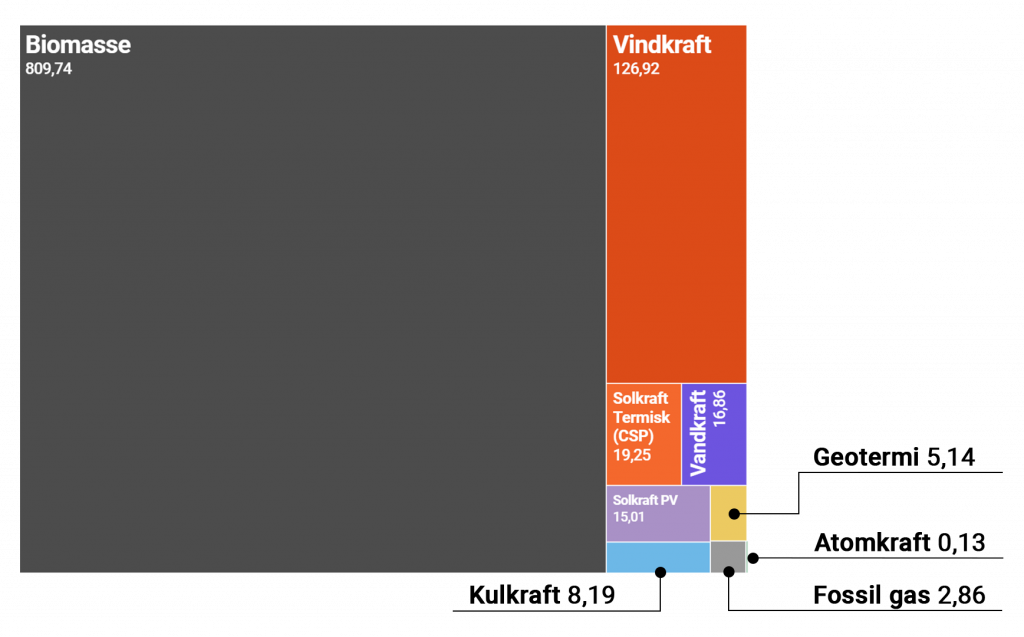
Area intensity km2/TWh for several electrical energy sources. From the source, total land consumption, including the required distance between units (km2/TWh), is used to achieve the specified energy density. For example, you have to place wind turbines at a relatively large distance so that the turbines do not brake on each other’s wind. The estimates for wind power are only based on onshore wind turbines, as there are currently insufficient scientific GPS analyses of offshore wind turbines. The figures relate exclusively to the direct land consumption at the power plants and do not include the area footprint of the materials used to build the power plant. Suppose these figures are included in the imprint. In that case, weather-based energy will look even worse, as these energy sources are uniquely material-intensive due to their low energy density (see a figure of material consumption at the end of this analysis or the table on p. 390 here). There are several similar estimates of land use in recent research articles that also use the GPS method, see here and here.
It immediately stands out that nuclear power is uniquely modest, as nuclear power requires only 0.13 km2 to produce one terawatt-hour of power. Nuclear power’s low area consumption per hour of electricity directly expresses nuclear energy’s unique energy density: Uranium contains about 2 million times as much energy as coal, and you can produce vast amounts of energy in almost no space.
This is opposed to land-hungry wind energy, which requires a whopping 127 km2 to produce the same amount of power. That is a difference of almost a factor of a thousand in favor of nuclear power.
Hydropower and solar power are the second most land-intensive energy sources. However, hydropower has the advantage that the production from the dam’s turbines can be controlled and adapted to electricity consumption, whereas solar power is highly weather-dependent and seasonal. In addition to a large area of consumption, the disadvantage of hydropower is that it requires rivers and mountains, which many countries, including Denmark, do not have. Geothermal energy is the only renewable energy source that has an energy density on par with fossil sources. Unfortunately, good geothermal sources are rare, and it is not an energy source that Denmark or most other countries can use significantly. Thus, in the following, we will primarily compare nuclear power with solar power, wind power, and biomass, as these are available in Denmark.
While wind power takes up about 1000 times as much space as nuclear power, biomass is even worse. Biomass, mainly wood, requires more than 6,200 times as much land as nuclear power. It is wild that “green” Denmark almost gets 1/3 of its energy from such an area-intensive energy source because biomass also emits CO2 and toxic air particles like coal.
What if all energy consumption had to be covered by weather-based energy sources alone?
It is an exciting thought experiment on how much of Denmark’s area would be dedicated to energy production if we chose to get 100% of our energy from the respective energy sources.
Denmark’s total energy consumption in 2019 was 193.5 terawatt-hours, and our land area is 42,933 km2. This gives you the following results:
If Denmark got its energy exclusively from burning forests in power plants, it would require an absurdly large energy forest, which would be 3.6 times larger than the entire area of Denmark.
Wind power also looks problematic, requiring 57% of Denmark’s land area. Jutland would thus be one large wind farm if we ran exclusively on wind energy. Based on the many wind turbine projects that have met with local opposition, it seems unrealistic to get Jutland on board with this idea.
One hundred percent nuclear power would require just 0.05% of Denmark’s area, corresponding to 1/5 of Samsø. Visually, 100% wind energy or 100% biomass would look like this:
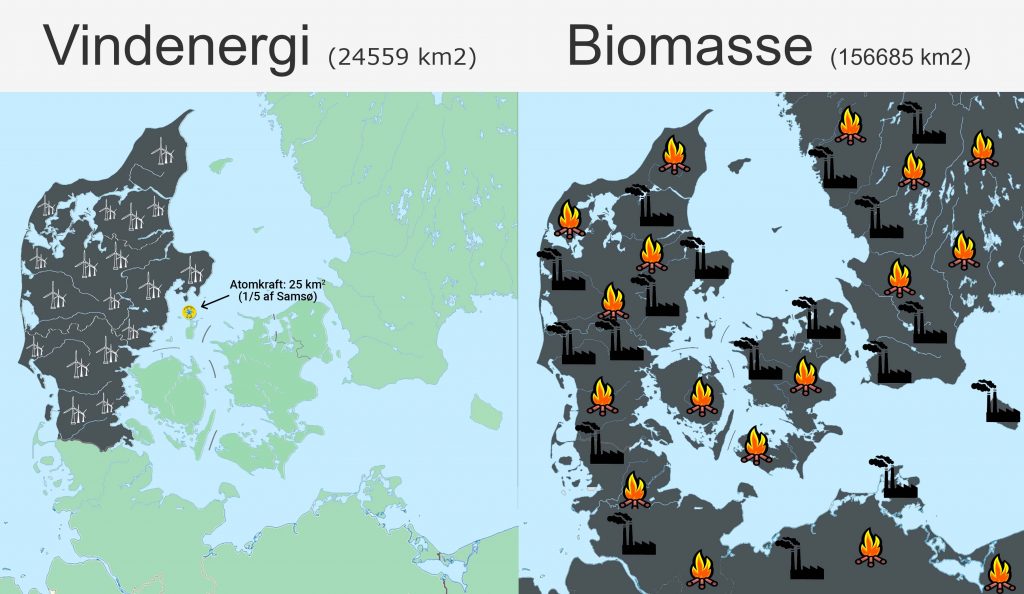
The graphic above illustrates how much area wind and biomass will require to cover Denmark’s total energy consumption.
Many large industrial countries have a higher energy consumption per square kilometer than we have in Denmark, and therefore Denmark’s area problem is not unique:
One of the world’s most renowned energy analysts, Vaclav Smil, can confirm the calculations in this analysis. Smil believes that if Germany and the UK were to be based on 100% renewable energy, their entire land area would have to be dedicated to producing wind, solar power, and biofuels. The situation is even worse in countries such as Japan, the Netherlands, and South Korea, which are far from being able to cover their energy consumption, even if their entire land area is dedicated to renewable energy production. Smile concludes:
“Power densities matter, and this means that the transition from predominantly fossil fuel-based to purely renewable energy systems cannot occur – even in affluent, populous countries with large territories and excellent conditions for PV-based and wind electricity generation”.
The above calculation is even generous
The Danish land consumption for solar and wind power will be even higher than in the above calculations for two reasons. The first is better wind and solar conditions in the United States, where the above figures for energy sources’ land use come from.
American onshore wind turbines produce 35% of the energy they have the capacity for. This is because the wind only sometimes blows with optimal conditions. A wind turbine with a total of 1 megawatt can thus deliver an average of 0.35 megawatts because the capacity factor of American wind turbines is 35%. However, the capacity factor of 35% is 1.3 times higher than Danish onshore wind turbines, which have a capacity factor of 27%. Therefore the area consumption of Danish wind power will be higher than in the above calculations.
American solar cells are primarily found in sunny states such as California and have a capacity factor of 25%, 2.8 times as productive as solar cells in sun-poor Denmark, where the capacity factor is just 12%.
The second reason why land use will be even higher is that the above calculations assume a perfect match between energy production and energy consumption, i.e., we excluded consuming energy when the wind blows.
Of course, this does not apply since we consume energy when needed, not only when the wind blows. Therefore, the one hundred percent wind scenario requires that you store wind energy when there is a lot of it and then use it when there is little. However, storage entails an energy loss; in reality, we must produce wind energy corresponding to our energy consumption and loss. Furthermore, it also requires extra energy, and thus more wind turbines, to build the energy storage system in giant battery parks.
So how much energy do we need to store? As the figure below shows, energy production from wind turbines is lower in the summer than in the winter, while energy consumption is more or less constant throughout the year:

From these percentage differences, it can be calculated that there is an energy deficit in 6 months of the year, which totals 17.82 TWh. This corresponds to almost a tenth of Denmark’s current annual energy consumption, which we must store.
When energy is stored, some of the energy is lost in the process. In the table below, we show the actual area consumption in the scenario with one hundred percent wind energy, when adjusted for both the lower capacity factor of Danish wind energy and for the energy loss of different types of energy storage:
It should be emphasized that these are just thought examples. Not all storage solutions are coherent in practice, as the cost of energy storage on this scale is astronomically high. In an American context, for example, researchers have estimated that the cost of sufficient storage via batteries in a scenario with 100% wind and solar power would cost Americans $23 trillion. This is equivalent to more than the entire GDP of the United States just for energy storage.
The relationship between energy and mass
As we have seen, energy sources with high energy density can create ample energy in quite a bit of space. Therefore, energy machines that use intense energy with high energy density take up less space than machines that capture weak energy from large areas.
You can see wind turbines as large sails that spread out into nature to collect nature’s unconcentrated energy flows. The wind turbine’s blades capture the relatively weak energy from the wind, and the generator in the turbine then converts the soft motion energy into concentrated electricity that we can use.
To capture enough wind energy to power a modern society with a high demand for concentrated energy, many wind turbines are needed.
This is opposed to nuclear energy. Since nuclear energy is highly concentrated, only a few energy machines are needed in the form of nuclear power stations. Therefore, nuclear energy can generate vast amounts of concentrated energy with a small footprint.
Energy density has an impact not only on land use but also on resource consumption in general. The U.S. Energy Agency has reviewed the available data and concludes that wind power requires ten times as many raw materials as nuclear power.
The graphic below shows how many raw materials it takes to build energy machines that can produce the same amount of energy. The unconcentrated renewable energy sources are all very material-intensive compared to nuclear energy.
Note: Since the figures cover materials to build the power plant and not to obtain energy fuel, the total material requirements of nuclear power are slightly higher, but due to the high energy density of uranium, very little fuel is required per amount of energy production.
The laws of physics do not bow to political preferences. If a society is based on energy sources that do not have high energy densities, more resources, and a larger area must be taken up to capture enough weak energy.
Conversely, if a society is based on energy sources with high energy density, you only need a few materials or areas. Increased energy flow means low material flow.
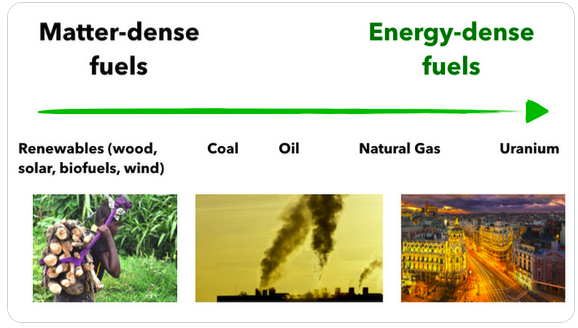
The figure below illustrates the continuum between mass and energy. The more energy an energy source contains the less mass and area needed to produce energy.
With nuclear power, we can solve climate challenges without compromising nature
Wind and solar are natural energies, but the machines that harvest these raw energies and feed them into our sockets are anything but natural. Nature is not helped by digging it up and filling it with energy machines on the pretext of saving the climate. We need to ensure that our climate solutions are beneficial and not detrimental to nature, which is already challenged by man’s large footprint.
With nuclear power, we can get lots of climate-friendly energy in a minimal area and thus make room for more wild nature. It all boils down to the astronomical amounts of energy found in uranium atoms. Uranium is created when supernovae explode, one of the universe’s most energetic phenomena. In the explosion, atoms and energy are squeezed together, producing uranium, an energy package of condensed supernova energy. These mysterious nuggets of pure energy from ancient times in our galaxy hold magical potential.
All we have to do is unleash the magic. If we do this, we can get plenty of energy to ensure humanity’s well-being and progress while having a minimal impact on both the climate and nature’s ecosystems.
The typical counter-argument among the old-fashioned environmental movement is that we should stop using much energy, as we would not need energy machines. We have analyzed why this low-energy utopia is neither realistic nor desirable, which you can read here.